 We stayed at the Casino Park Hotel, of interest to us because it was designed by Oscar Niemeyer, the Brazilian architect of many of the public buildings in the new city of Brasilia.
 The present owners are the Pestana family, who are obviously very proud of the history of this building as they commissioned a smart coffee table book detailing its conception and construction. A copy was placed in our room but unfortunately the English 'translation' was largely unintelligible. The hotel maintains all the original design features in its interior furnishings.
 "It is not the right angle that attracts me, nor the straight line, hard and inflexible, created by man. What attracts me is the free and sensual curve - the curve that I find in the mountains of my country, in the sinuous course of its rivers, in the body of the beloved woman."
 Cantilevered balconies provide sitting places for gazing out to sea.


 The circular casino seen from the grounds of the hotel.


 Niemeyer also quotes Le Corbusier who said, "Outline, in architecture, is the original stroke, the basic idea, the architectural invention."
Neimeyer was a pioneer in the use of reinforced concrete used solely for aesthetic impact. He designed the hotel and casino whilst living in Paris in the '60's and 70's as an exile from the regime in Brazil. His buildings are often characterised by being spacious and exposed, mixing volumes and empty spaces to create unconventional patterns.
"From a line architecture is born. When it is beautiful and creates surprise it can attain, being well driven, a superior level of a work of art."
 "It is not the right angle that attracts me, nor the straight line, hard and inflexible, created by man. What attracts me is the free and sensual curve - the curve that I find in the mountains of my country, in the sinuous course of its rivers, in the body of the beloved woman."
 Cantilevered balconies provide sitting places for gazing out to sea.


This period of building is very unfashionable now, with elements that remind me of a municipal car park. Nevertheless it is interesting to see these buildings so cherished and functioning well.

 A curving walkway links the hotel to the casino building.

 A curving walkway links the hotel to the casino building.
 The circular casino seen from the grounds of the hotel.

 Niemeyer also quotes Le Corbusier who said, "Outline, in architecture, is the original stroke, the basic idea, the architectural invention."
 and Zevi, "architecture is like a huge hollow sculpture inside which the man enters , walks and lives."
 In these buildings he uses the spiral shape for the first time, a shape that he would use again in later projects.


 The dining room looks out across the pool to the harbour where most evenings one or two cruise ships dock, sailing out the following evening. The entrance to the dining room is via a wide, curving ramp that creates a very grand entrance!

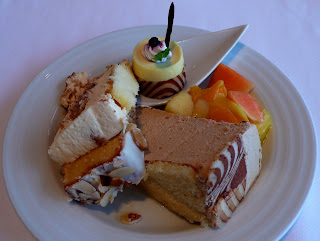 Last night's dessert plate necessitates an early morning swim!

 The great advantage of an unheated pool is that you can have it all to yourself.
 In these buildings he uses the spiral shape for the first time, a shape that he would use again in later projects.


 The dining room looks out across the pool to the harbour where most evenings one or two cruise ships dock, sailing out the following evening. The entrance to the dining room is via a wide, curving ramp that creates a very grand entrance!
 Last night's dessert plate necessitates an early morning swim!
 The great advantage of an unheated pool is that you can have it all to yourself.
Once you are in it is great - it's just the getting in that is hard work!
(There was also a well heated indoor pool, a sauna, jacuzzi and hammam where Himself melted daily.)


