Wednesday, 12 June 2013

Out and about

Last week we had a lovely time catching up with friends and family. We went to the Yorkshire Dales and it's amazing the difference that a few weeks can make. The landscape was lush with growth.

Remember how it looked at the beginning of April?
We walked down through the fields

to the river,
 one of my favourite places.
It involves stepping on stones to cross the water, 
something that I can still just about manage to do without falling in!
Midweek we drove to Whitby on the east coast to stay with brother and sister-in-law, (where we were spoilt rotten!) Their holiday apartment is set on the river with lots to look at from the windows. 

It is just a pleasant walk away from the centre of the town.


We climbed the 199 steps up to the abbey
and looked at the weathered tomb stones
then walked back down via the donkey path.
which is steep!
There had been a bad landslip on the hillside a while ago, threatening the famous kipper smoke house below. Can you see the metal mesh put in place to stop further erosion? There were no kippers for sale.
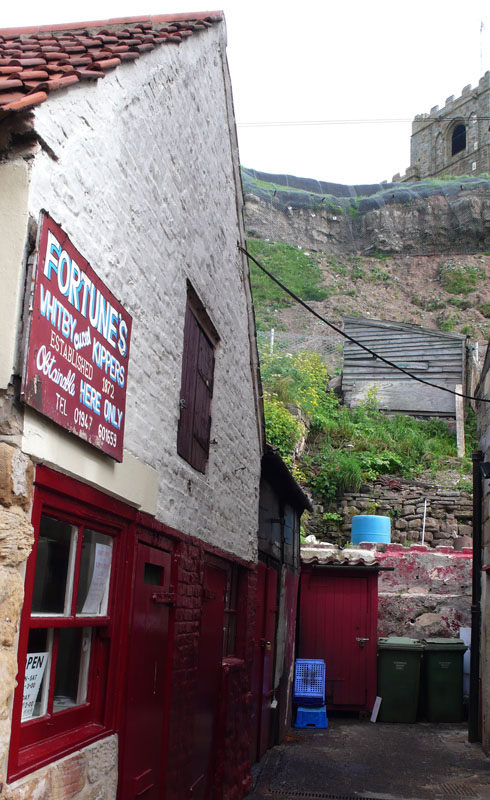
Then we walked to the other side of the town.


(These days countless  Draculas, vampires and the like descend on Whitby every halloween.)
The jaw bone of a whale, a present from Alaska, frames the abbey
and close by is a statue of Captain Cook. 
(Those seagulls get everywhere.)

After all that strolling we went to Botham's tea shop


The ladies told us the history of the shop
and I studied the 'fancies'.
There were lots of tasty things to buy.
Himself 'took' afternoon tea.
Not bad, considering he'd had a fish and chip supper the previous evening!
I had fish pie.
When you're in Whitby you have to eat at Trenchers.
What's not to like!

Tuesday, 28 May 2013

Excluded

Ouranopolis tower, early morning, Saturday 18th May 2013.

Our menfolk are going to visit Mount Athos and females are not allowed. The hotel bus takes the four of us into town, the men to queue for their pilgrim visas and the ferry boat while Heidi and I set out to walk, in the cool of the early morning, to the Athonite monastery of Zygou, founded in the early tenth century, which lies just outside the autonomous republic of Mount Athos.
We head out of town along a dusty road. Parcels of cultivated land are fenced and guarded by dogs, alert to our presence, heads raised from sleep, eyes watchful. Some of them trail our footsteps along their perimeter fencing. A puppy, not yet trained to be forbidding, comes bouncing and wriggling with delight to see us, whist its mother barks a warning.

Wild flowers and silence.
Zygou monastery

Zygou monastery is a tumble of stones. The ticket office is closed, the site padlocked. Beyond a dry stream bed a high metal barrier, rolls of barbed wire and a large sign warning of punishment for trespass mark the boundary of Mount Athos. A thin black cat comes to greet us, walking stiffly on a damaged leg, waving her tail as a flag of welcome. She is covered in sores. We would like to return her friendship. "Hello," we say, but do not let her near enough to rub against our legs.
Perhaps the ticket office will open soon. We walk to the beach, the black cat between us, and look for the ferry that is taking our men to the mountain. It comes into view on a swell of water, not riding the waves well but hitting and rolling. We hope that the 'Qwells' are working well!

The cat sits on a large beach pebble biting at fleas and washing her belly. An hour passes. Waves crash against the shore. The barbed wire barrier extends into the sea. It reminds me of newsreel images that I have seen of war zones. I find it offensive. Here we sit, three females, if you include the cat, all excluded. We return to the monastery and look in disgust at the padlock that bars our entry.
It is getting hot. We walk back along the dusty road towards the town. A snake slithers away from us into the undergrowth. The flowers still bloom but the sense of exclusion has tainted the morning.

Monday, 27 May 2013

Mainland Greece

We have just returned from our first holiday to mainland Greece, where we went in search of warmth and sunshine. We were not disappointed. Indeed, so unused are we to sun that after a few days , in consideration of our skin, we had to skulk in the shade. We took the hotel bus into Lerissos town where we had been told that the market was wonderful and you could buy "everything".
We passed the boat builders yard
and expectations were running high.
Good fruit and vegetables. a tempting stall with a mound of cherries, some local honey, which I bought, along with a couple of packets of herbs, but otherwise, what a load of tat!
We wandered about town where there seemed to be little to see. (And passed a bit of time while waiting for the returning bus by eating ice-cream!) Then we spotted this church
and found that a side door was open.
We picked our way past scaffolding and entered into a riot of colour and imagery.
Icons were everywhere and the walls and ceiling were beautifully painted.

Fresh flowers decorated this icon
and dried flowers, or more accurately, fresh flowers that had died, covered a large structure, creating a strange fuzzy, mossy surface.
It was silent in the church and I thought that we were alone
until a few slight noises above made us look up and discover a man on top of the scaffolding painting on the ceiling.
How wonderful - it's not every day that you find a man painting angels! It reminded me of J.L. Carr's gentle little book, "A Month in the Country" which is set in 1920 and tells the story of a young man, a survivor of the Great War, who comes to a village church to uncover a wall painting.

When we were back at the hotel I asked about the church and the meaning of the flower-covered structure.It is St Nicholas Church and the structure represents the body of Christ. It is decorated with fresh flowers every Good Friday by the local women. After the Friday service it is carried around the town by four men in a procession on a route that creates a cross to bless the entire community. People line the streets. It is then returned to the church and set high inside the door so that as people enter they walk beneath the structure and receive a blessing. After  a period of time it is placed where I saw it and the flowers remain for forty days before being taken down.